
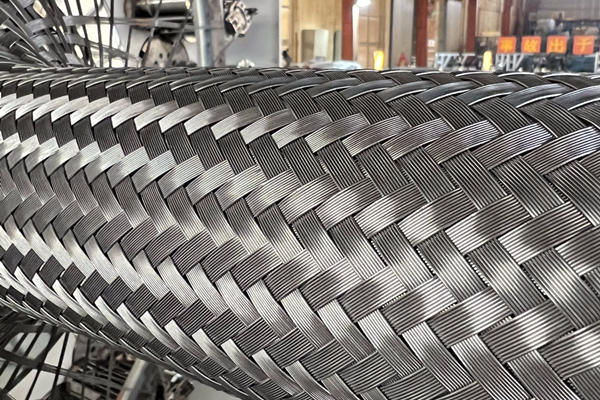
Wire braiding is widely used in products such as metal hoses, flexible conduits, cables, and reinforced tubing. A stable braiding process improves product strength, appearance, and service life. However, many manufacturers face one common problem during production: a high wire braiding overlap rate.
If the overlap rate is too high, the braided layer may become too dense, uneven, and visually irregular. In addition, excessive overlap can increase material consumption and reduce product flexibility. Therefore, reducing the wire braiding overlap rate is essential for improving product quality and production efficiency.
What Causes a High Wire Braiding Overlap Rate?
Before solving the problem, manufacturers need to understand the reasons behind it. In most cases, a high wire braiding overlap rate results from poor coordination between braiding speed, traction speed, wire tension, and braiding angle.
Common causes include:
- The braiding speed is too fast
- The core tube or hose moves too slowly
- The wire tension is unstable
- The braiding angle is too small
- The carrier movement is not synchronized
- The machine settings do not match the product specification
When these factors are not properly balanced, the wire may cover the same area too much, which increases the wire braiding overlap rate.
Why Is It Important to Reduce the Wire Braiding Overlap Rate?
A proper wire braiding overlap rate helps create a uniform and stable braid structure. However, if the overlap is too high, several problems may appear during production.
- The braided layer may become too thick or uneven
- Product flexibility may decrease
- Raw material consumption may increase
- Production efficiency may drop
- The final product may fail to meet customer requirements
For this reason, manufacturers should pay close attention to overlap control throughout the braiding process.
How to Reduce the Wire Braiding Overlap Rate
To reduce the wire braiding overlap rate effectively, operators should adjust production parameters step by step. Below are several practical methods.
1. Adjust the Braiding Speed Properly
Braiding speed has a direct effect on the wire braiding overlap rate. If the braiding machine runs too fast while the hose or core tube moves too slowly, the wire will overlap more heavily in the same area.
Therefore, one effective solution is to reduce the braiding speed or increase the linear speed of the core tube. This helps create a more balanced braid pattern. However, the adjustment should remain moderate so that braid stability is not affected.
2. Increase the Core Tube Traction Speed
The traction speed of the core tube, hose, or inner liner must match the braiding speed. If the traction speed is too low, the braided wire stays in one area for too long. As a result, the wire braiding overlap rate increases.
By increasing the pulling speed within a suitable range, manufacturers can reduce wire accumulation and achieve a more uniform braid structure.
3. Optimize the Braiding Angle
The braiding angle strongly influences braid structure. A smaller braiding angle often creates a tighter and denser braid, which may increase the wire braiding overlap rate. In contrast, a slightly larger angle can help spread the wire more evenly.
Therefore, operators should check whether the current braiding angle matches the product design and technical requirements. If necessary, they should adjust the machine settings accordingly.
4. Keep Wire Tension Stable
Unstable wire tension is another important reason for poor braiding quality. If tension changes during operation, the wire may not lay evenly on the product surface. Consequently, local overlap may become more serious.
To maintain stable tension, manufacturers should:
- Check the tension control system regularly
- Inspect the wire spool condition
- Ensure smooth wire feeding
- Replace worn tension components in time
Stable tension helps reduce the wire braiding overlap rate and improves overall braid consistency.
5. Check Carrier Synchronization
In a braiding machine, all carriers should move smoothly and synchronously. If one or more carriers run abnormally, the braid pattern may become irregular, which can lead to local overlap or uneven coverage.
For this reason, operators should inspect:
- Carrier running condition
- Gear wear
- Track cleanliness
- Lubrication condition
- Mechanical transmission stability
A well-maintained braiding machine can significantly reduce defects and keep the wire braiding overlap rate under control.
6. Select the Right Wire Diameter and Braid Density
Sometimes the problem does not come only from machine settings. It may also result from an unsuitable material combination. If the wire diameter is too large or the braid density is too high for the product design, excessive overlap becomes more likely.
Therefore, manufacturers should review whether:
- The wire diameter matches the product size
- The braid density is appropriate
- The number of carriers is suitable
- The design standard allows optimization
A correct process design is the foundation for reducing the wire braiding overlap rate.
7. Perform Trial Adjustments and Record Data
In actual production, the best results often come from repeated testing and process improvement. Instead of relying only on experience, manufacturers should record key data during production, such as:
- Braiding speed
- Traction speed
- Braiding angle
- Wire tension
- Product diameter
- Braid appearance
By comparing these values, operators can identify the best parameter combination for reducing the wire braiding overlap rate while maintaining product quality.
Practical Tips for Better Braiding Quality
Besides lowering the wire braiding overlap rate, manufacturers should also focus on overall braiding quality. A stable process usually delivers better performance and fewer defects.
Useful tips include:
- Clean and maintain the braiding machine regularly
- Train operators to recognize abnormal braid patterns
- Use high-quality wire materials
- Inspect braid appearance during production
- Standardize machine settings for different product models
Conclusion
Reducing the wire braiding overlap rate requires a balanced and systematic approach. Manufacturers should not focus on only one parameter. Instead, they should adjust braiding speed, traction speed, braiding angle, wire tension, and machine synchronization together.
When process parameters are properly matched, the braid becomes more uniform, material waste decreases, and product quality improves. In addition, a lower wire braiding overlap rate helps manufacturers increase efficiency and better meet customer expectations.
If you want to improve your wire braiding process, the key is to analyze the root cause first and then make targeted adjustments based on actual production conditions.