
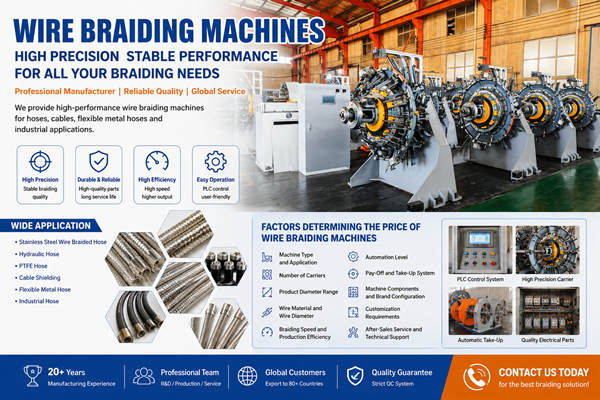
When customers plan to purchase a wire braiding machine, price is usually one of the first concerns. However, the cost of a wire braiding machine is not fixed. It depends on many technical and production factors, such as machine structure, number of carriers, wire diameter range, braiding material, automation level, production speed, and customized requirements.
Understanding these factors can help buyers choose the right machine according to their product needs, production capacity, and investment budget.
1. Machine Type and Application
The first factor affecting the price is the type of wire braiding machine. Different applications require different machine designs.
Common applications include:
- Stainless steel wire braided hose
- Rubber hose reinforcement
- PTFE hose braiding
- Hydraulic hose braiding
- Cable shielding braiding
- Flexible metal hose outer braiding
- Composite hose or industrial hose reinforcement
For example, a braiding machine used for stainless steel wire braided hose may require stronger mechanical structure and higher tension control than a machine used for light cable shielding. Therefore, machines for heavy-duty industrial applications usually cost more.
2. Number of Carriers
The number of carriers is one of the most important factors determining the price of a wire braiding machine. Carriers hold and guide the wire bobbins during the braiding process.
Common configurations include:
- 16-carrier wire braiding machine
- 24-carrier wire braiding machine
- 32-carrier wire braiding machine
- 36-carrier wire braiding machine
- 48-carrier wire braiding machine
- 64-carrier wire braiding machine
- 72-carrier wire braiding machine
- 96-carrier wire braiding machine
Generally, the more carriers a machine has, the higher the price will be. More carriers mean a more complex machine structure, more precision parts, higher manufacturing cost, and greater braiding capability.
A higher carrier count can produce denser braiding coverage and handle larger-diameter products, but it also increases the equipment investment.
3. Product Diameter Range
The required product diameter range directly influences machine size and structure.
A machine for small-diameter hoses or cables has different design requirements from a machine for large-diameter industrial hoses. Larger products usually require:
- Bigger machine frame
- Larger horn gear or braiding plate
- Stronger transmission system
- Higher motor power
- Larger bobbin capacity
- More stable tension control
Therefore, a wire braiding machine for large-diameter hoses is usually more expensive than a standard small-diameter machine.
4. Wire Material and Wire Diameter
Different wire materials have different strength, hardness, and processing requirements. Common braiding materials include:
- Stainless steel wire
- Galvanized steel wire
- Copper wire
- Tinned copper wire
- Aluminum wire
- Textile yarn or fiber reinforcement
For stainless steel wire braiding, the machine needs higher rigidity, better wear resistance, and more stable tension control. If the wire diameter is larger, the mechanical load will also increase, which may require stronger carriers, gears, motors, and transmission components.
As a result, machines designed for thicker or harder wire materials normally have a higher price.
5. Braiding Speed and Production Efficiency
Production speed is another key factor. A higher-speed wire braiding machine requires better mechanical precision, more stable transmission, and stronger dynamic balance.
A high-speed machine can improve production efficiency, reduce labor cost, and increase output. However, it also requires higher-quality components and more advanced manufacturing accuracy.
Therefore, when comparing prices, customers should not only check the machine cost, but also consider long-term productivity and return on investment.
6. Automation Level
The automation level has a significant impact on the machine price.
Basic machines may require more manual adjustment and monitoring, while advanced machines may include:
- PLC control system
- Touch screen operation
- Automatic lubrication system
- Automatic wire break detection
- Automatic stop function
- Digital speed control
- Tension monitoring system
- Safety protection system
- Automatic take-up and pay-off system
A higher automation level increases the initial investment, but it can improve operation convenience, reduce human error, and make production more stable.
7. Pay-Off and Take-Up System
A complete braiding production line usually includes not only the braiding machine itself, but also the pay-off system and take-up system.
The final price may be affected by:
- Manual or automatic pay-off
- Tension-controlled pay-off
- Single-station or double-station take-up
- Bobbin size and loading capacity
- Servo control or frequency control
- Traversing accuracy
- Line speed synchronization
For customers who need continuous production and stable winding quality, an advanced pay-off and take-up system is highly recommended, but it will also increase the total equipment cost.
8. Machine Components and Brand Configuration
The quality and brand of key components also influence the price of wire braiding machines.
Important components include:
- Motor
- Reducer
- Bearings
- Gears
- Electrical components
- PLC and touch screen
- Inverter
- Sensors
- Lubrication system
- Safety devices
Machines using high-quality components usually have better stability, longer service life, lower failure rate, and easier maintenance. Although the purchase cost may be higher, the long-term operating cost can be lower.
9. Customization Requirements
Many customers need customized wire braiding machines according to their product specifications and factory conditions.
Customization may include:
- Special product diameter range
- Special wire diameter
- Higher braiding coverage requirement
- Special bobbin size
- Customized machine layout
- Extra safety protection
- Special voltage and frequency
- Integration with existing production lines
- Customized pay-off and take-up design
The more customized the machine is, the more engineering design, production adjustment, and testing work is required. Therefore, customized solutions usually cost more than standard machines.
10. Testing, Installation, and After-Sales Service
The price of a wire braiding machine may also include service-related costs, such as machine testing, packaging, shipment support, installation guidance, operator training, spare parts supply, and after-sales service.
For international buyers, reliable technical support is very important. A professional supplier should provide clear operation manuals, maintenance guidance, and timely support when customers need help.
Choosing a machine only based on the lowest price may lead to higher risks in operation, maintenance, and production stability.
How to Choose the Right Wire Braiding Machine
Before requesting a quotation, customers should prepare the following information:
| Required Information | Why It Matters |
|---|---|
| Product type | Determines machine structure and application |
| Product diameter range | Affects machine size and carrier configuration |
| Wire material | Influences tension and machine strength |
| Wire diameter | Determines carrier and transmission design |
| Required braiding coverage | Helps select carrier number |
| Production speed requirement | Affects motor, control system, and machine precision |
| Bobbin size | Determines carrier and take-up design |
| Automation requirement | Influences control system and total price |
| Voltage and frequency | Required for electrical configuration |
With this information, the supplier can recommend a more accurate machine model and provide a more reasonable quotation.
Conclusion
The price of a wire braiding machine is determined by many factors, including machine type, number of carriers, product diameter range, wire material, wire diameter, production speed, automation level, component configuration, customization requirements, and after-sales service.
For buyers, the best choice is not always the cheapest machine, but the machine that best matches the production requirements and provides stable long-term performance.
A suitable wire braiding machine can help improve production efficiency, ensure consistent braiding quality, reduce labor cost, and create greater value for hose, cable, and industrial product manufacturers.